


Biogas Plants (Biodigesters)
Design
Construction
Services for Biogas Plants

World Leader
In POME treatment and valorization (biogas / biofertilizer) since 1988.
Biogas Plants
More than 100 units designed, built and operated since 1984.
POME Biogas Plants
28 units designed, built and operated since 1988 (50% in Latin America).
BIOTEC biogas / biodigesters area designs, builds and installs biogas plants in regions of various countries since 1984.
Our Technology
Main biodigesters models developed by BIOTEC:
UASB
Upflow Anaerobic Sludge Blanket
RAC ®
Contact Anaerobic Reactor
RAFAC ®
Contact up Flow Anaerobic Reactor
RAS ®
Dry Anaerobic Reactor


On the other hand, these by-products have a high fertiliser value and energy potential. The bio-digestion of the “POME” in bio-digesters of the BIOTEC RAC model generates an average of 15 m3 of CH4 and 60 kWh per ton of fruit (FFB).
EFB fertilizer value is around 3 US$ per T FFB and POME fertilizer value is between 4 and 5 US$/T FFB.
Under the BIOTEC approach, there is no reason to send raw or treated POME to the river. These nutrients and this organic matter must go back to the soils.
BIOTEC developed the concept of the Zero Discharge Milling (ZDM) and developed several technologies to achieve it:
- Open ponds and open biodigesters + liquid fertilization.
- Biodigestion + liquid fertilization.
- Bio-evapo-drying to produce a powdered biofertilizer.
- Co composting with EFB (4 meters high heap / lateral turning / no roof requirement).
The bio-digesters are «biological engines» allowing the transformation of (liquid or dry) organic matter into biogas and stabilised organic fertiliser.
Biogas plants are facilities with three purposes
- Treat the organic matter (liquid or solid) by biological process.
- Generate a renewable natural gas for energy usage.
- Stabilize the organic material for its better use as fertilizer.
Biodigesters convert organic matter (carbon), into methane (CH4) and carbon dioxide (CO2). The macro and micro nutrients are not removed by the anaerobic digestion. Both treated effluent as well as sludge can be valorized as liquid or solid biofertilizers as part of the BIOTEC concept of Zero Discharge Milling (ZDM).
What differentiates us
IMPLEMENTATION
BIOTEC designs, builds, implements, supervises, inoculate and commission its solutions on an industrial scale.
1. Full/partial turnkey
BIOTEC is responsible for the entire project, from the design and construction of the plant to the commissioning.
As an option, the client can assume civil works and/or buy some equipment directly.
2. Integral Engineering (EPC-EPCM)
Includes: design, supervision of works, inoculation, start-up (commissioning).
Can also include, as an option, a support for purchases and/or project management.

OPERATION
BIOTEC usually operates its plants for up to two years, or supports its clients in the routine operation all the time required. By this way, BIOTEC commits with the KPI for a long period and the client benefits from its experience and from technology upgrading year after year.
It is definitively more comfortable for (biogas, composting, fertigation or bio-drying) plants operators to have a permanent support from the designer (on-site or remote).
Two modalities:
Management:
BIOTEC participates in the operation with its own staff, leading and training the client’s team.
Supervision:
On-line monitoring (SCADA system) with periodical audits.

BIOTEC designs and builds with the operation in mind.
Experience and Know-how
Pioneers
World Leader in Palm Oil Mill Effluents (POME) treatment and valorization since 1988.

2nd POME biodigester in the world
(Palmeras del Llano, Colombia, 1988)
1st Covered lagoon Biodigester for POME
(Palmeiras, Colombia, 1999)
1st CDM Project (Gold Standard) for POME in the world
(Eecopalsa, Honduras, 2007)
OPERATION

BIOTEC has been world leader on CDM projects for methane capture in the agro-industry between 2006 and 2012, during the Kyoto Protocol period, and in particular in the palm oil industry to reduce its Greenhouse Gases emissions.
Eight BIOTEC biogas projects have been registered by UNFCCC (United Nations) as CDM during that period, with an average methane capture of 40.000 tons CO2 per project per year.
The Eecopalsa project in Honduras (# 492 of the CDM list), commissioned by BIOTEC in August 2006, has been the first one for the palm oil industry. It has been operated by BIOTEC for five years, what means during all the KYOTO period. BIOTEC has therefore overseen the five annual audits, reaching every year the maximum number of CERs (Certificates) allowed by the PDD (Project Design Document).
Research, Development and Innovation
Research, development and innovation has always been the strength of our evolution. We optimise and constantly renew our products and look for new solutions to the challenges presented to us.

Our department responds to external and internal requests, using a diverse range of media, such as laboratory tests, industrial testing, collaboration with equipment suppliers, literature searches and feedback from our plants in operation.
The department has a well-equipped research laboratory to carry out experiments in BMP (Bio methane Potential), and Methanogenic activity. These facilities also allow to assess the toxicity of a given compound, as well as the influence of particle size, temperature and other parameters.
Our lab biodigesters can also work under continuous operation to be able to get reliable data on organic loads, yields, gas quality, nutrient deficiencies, etc.
Our partner SSP (sspindia.com) on its side has a ½ hectare R&D Center on Evaporation and Drying (in Faridabad, India) with all the models for testing.
Our R-D lines:
Optimisation of existing systems
- New feedstocks
- New concepts
Robust biological systems to eliminate H₂S
- Gas farms: Energy crops for biogas production that generate up to 12,000 m³ of methane per hectare per year from forage in humid tropical regions.
- Metallic tanks from 1,000 to 15,000 m³ quick assembly.
- Higher level of containerization and automation.
PRODUCCION DE BIOGAS DE LAS PLANTAS BIOTEC
90 Millones m3 CH4/año
- Producción de metano durante el año 2019 de los biodigestores construidos por BIOTEC.
- El gas es usado para la generación de vapor y electricidad.
600 Millones
De biodigestores construidos en los últimos diez años.
Forms of hiring
BIOTEC offers biogas projects with contracts in various modalities.
- “Llave en mano” o contrato de EPC (Enginering, Procurement and Construction), que incluye ingeniería, compras y construcción.
- “Llave en mano parcial”, donde BIOTEC se encarga de la ingeniería y gestión del proyecto, pero con posibilidad de diferentes alcances de suministro, donde, por ejemplo, las obras civiles pueden quedar a cargo del cliente, así como la compra de algunos equipos.
- Ingeniería con responsabilidad total del resultado y donde BIOTEC es responsable de conceptualización, diseño, supervisión de obras/montaje, inoculación y puesta en marcha del sistema.
Conceptual engineering / Feasibility studies / Audits
When a client is not defined in advance about the project to implement to treat and valorize effluents and waste, BIOTEC advises to hire a preliminary phase of “Conceptual engineering” to evaluate options, with their advantages, disadvantages and approximate costs, looking for the most appropriate to its specific case. This phase requires a wide experience of all available technologies and their costs. BIOTEC set-up two CONSULTANCY COMPANIES to do that specialized job.
See the window « CONSULTANCY » on this WEB site and the brochures and WEB sites of EVE (Effluents Valorization Engineering) and POME.
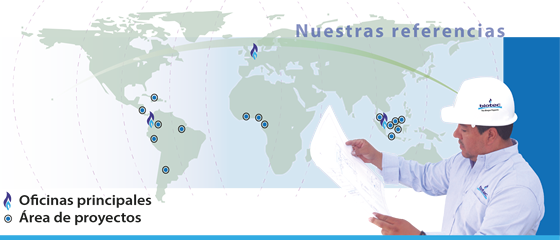
References
Projects executed in Latin America between 1985 and 2000
Colombia, Venezuela, Guatemala, Nicaragua, El Salvador
- Finca Chordelec (ganado lechero) – 1985
- Finca Andropa (cerdos) – 1986
- Palmeras del Llano (palma) – 1988
- Ingenio Mayagüez (caña) – 1989 – 1993 – 2003
- Carnes y Derivados de Occidente (Matadero de ganado) – 1989
- Cartones América (papelera) – Desde 1990 hasta 2020
- Palmar Santa Elena (palma) – 1991
- Emcali – PTAR «El Vivero» (aguas residuales domésticas) – 1993
- Ingenios Riopaila y Central Castilla (caña) – 1994
- Nabisco (vinazas de levadura) – 1996
- Agrosan (aguas de lavado de rendering) – 1997
- Restrepo (municipio – 10.000 habitants) – 1997
- Sololá (municipio de 20.000 habitants) – 1997
- Panajachel (municipio de 20.000 habitants) – 1998
- Friko (matadero de pollos) – 1998
- Fábrica de Café Liofilizado (café soluble) – 1999
- Tabacal (Urbanización) – 1999
- Hacienda las Flores (Urbanización) – 1999
- Palmeiras (palma) – 1999
- Colombina (fábrica de dulces) – 1999
- Bosques de Capistrano (condominio) – 2000
- Colanta Planeta Rica (industria láctea) – 2000
- Frigorifico Santa Elena (rendering) – 2001
- Ciudad Corinto (municipio de 20.000 habitants) – 2001
- Punta Gorda (urbanización) – 2001